The United Arab Emirates has developed into a major gateway for international trade, connecting businesses across Asia, Europe, Africa, and the Middle East. For companies looking to import goods into the UAE or export products to international markets, understanding each stage of the trading process is essential for controlling costs, managing timelines, and avoiding unnecessary delays.
The UAE Import & Export process involves much more than moving goods from one country to another. Businesses need to consider product sourcing, supplier verification, pricing, Incoterms, documentation, freight, customs declarations, duties and taxes, warehousing, and final delivery.
For companies without an established international supply chain, managing all these stages internally can be time-consuming and complex. This is where an experienced trading and sourcing partner can add significant value.
Forton General Trading provides global sourcing and trade solutions from Dubai, including product sourcing, customs clearance, freight and logistics, and warehousing support. Forton states that it has more than 15 years of experience and an international supplier network serving businesses across multiple industries.
This guide explains the UAE Import & Export process step by step, from identifying a product to delivering the shipment to the final customer.
How Does the UAE Import & Export Process Work?
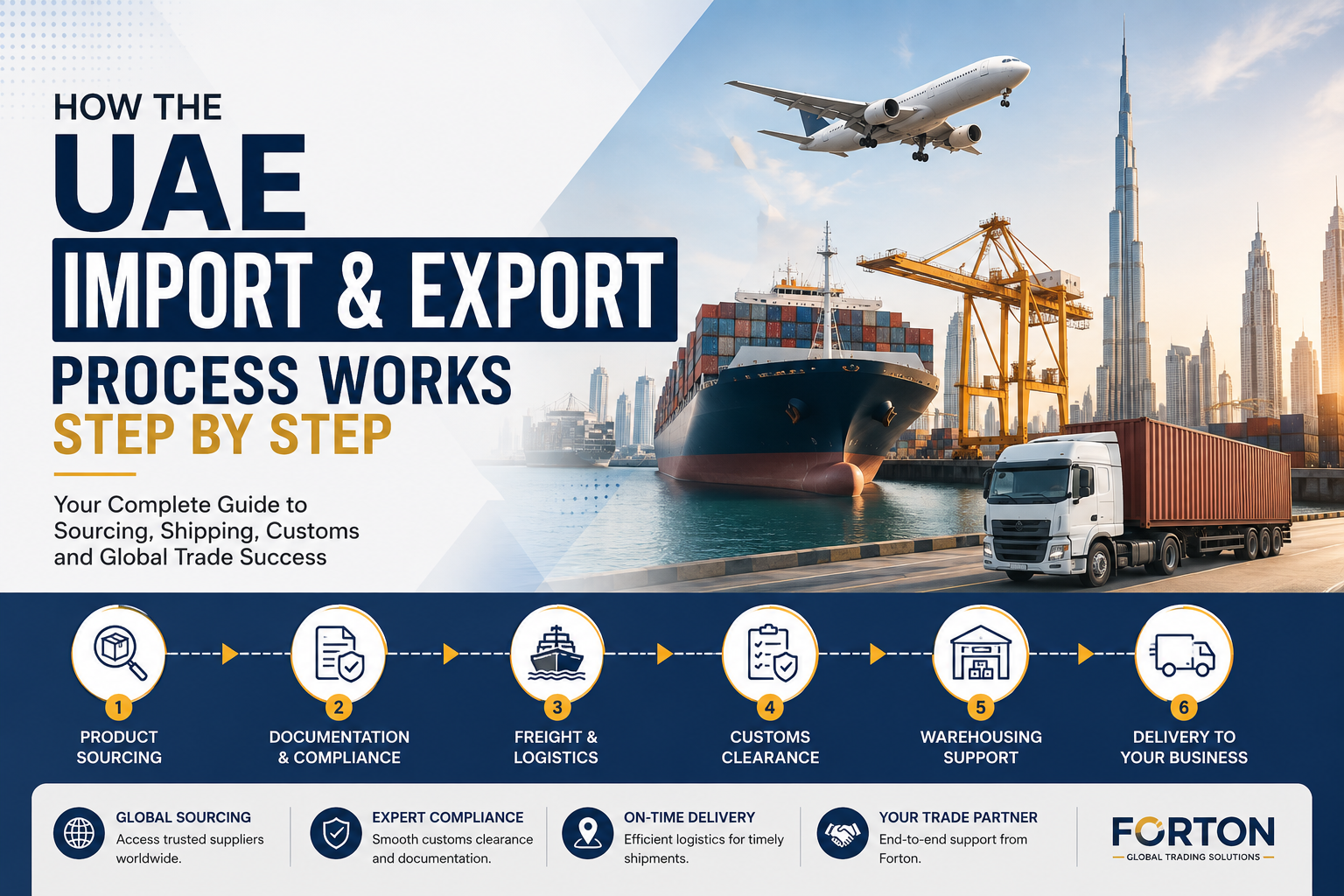
The UAE Import & Export process generally involves these key stages:
- Identify the product and requirements
- Find an overseas supplier
- Verify the supplier
- Negotiate pricing and commercial terms
- Confirm Incoterms
- Prepare import or export documents
- Arrange freight and logistics
- Submit the customs declaration
- Pay applicable duties and taxes
- Complete customs clearance
- Move goods to a warehouse
- Deliver products to the customer
The exact requirements can vary depending on the product, origin, destination, customs procedure, free-zone or mainland movement, and applicable regulations. Businesses should therefore confirm product-specific requirements with the relevant authorities before shipping.
Step 1: Identify the Product and Import or Export Requirements
The first stage is to clearly define what you want to import or export.
Businesses should establish:
- Product specifications
- Quantity
- Required quality standards
- Target price
- Intended market
- Packaging requirements
- Labelling requirements
- Delivery location
- Required certifications
Product classification is particularly important because customs treatment, permits, duties, and regulatory requirements can vary by product.
For businesses entering a new market, it is also important to research whether the product requires special approvals or documentation before placing a large order.
A clear product specification makes the next stage—supplier sourcing—far more efficient.
Step 2: Find a Reliable Overseas Supplier
Once the product requirements are established, businesses need to identify suitable international manufacturers, wholesalers, or exporters.
International supplier sourcing can involve comparing companies from manufacturing markets across Asia, Europe, the Middle East, and other regions.
Businesses should evaluate suppliers based on:
- Manufacturing capability
- Product quality
- Certifications
- Production capacity
- Minimum order quantity
- Lead times
- Export experience
- Payment terms
- Packaging capabilities
- References and business credentials
Choosing the cheapest supplier is not always the best strategy. A slightly higher unit price from a reliable supplier may result in lower overall costs when quality, delivery reliability, warranty issues, and rejected shipments are taken into account.
Forton’s product sourcing service focuses on supplier identification, evaluation, sample management, supplier audits, price negotiation, and ongoing supplier relationship management.
Step 3: Verify the Supplier
Supplier verification is one of the most important stages of international trade.
Before placing a significant order, businesses should conduct appropriate due diligence. This may include checking:
- Company registration
- Business licences
- Certifications
- Manufacturing facilities
- Product samples
- Export history
- Quality-control procedures
- References
- Production capacity
For larger or higher-risk purchases, businesses may consider factory inspections or independent quality inspections before shipment.
Supplier verification reduces the risk of receiving products that do not match the agreed specifications or dealing with an unreliable trading partner.
For businesses importing into the UAE, professional sourcing support can provide an additional layer of due diligence before the commercial transaction is finalized.
Step 4: Negotiate Pricing and Commercial Terms
After identifying a suitable supplier, negotiate the commercial terms before confirming the order.
Important points include:
- Unit price
- Minimum order quantity
- Production lead time
- Payment terms
- Packaging
- Product specifications
- Quality standards
- Warranty
- Shipping arrangements
- Delivery schedule
Businesses should calculate the total landed cost, rather than looking only at the supplier’s quoted product price.
For example, the final cost may include:
Product Cost + Freight + Insurance + Customs Duty + Taxes + Clearance + Handling + Warehousing + Local Delivery
Understanding the complete cost structure allows businesses to compare suppliers more accurately.
Step 5: Confirm Incoterms
Incoterms define responsibilities between buyers and sellers during international shipments.
Common terms include:
- EXW – Ex Works
- FOB – Free on Board
- CIF – Cost, Insurance and Freight
- CFR – Cost and Freight
- DAP – Delivered at Place
- DDP – Delivered Duty Paid
The selected Incoterm determines who is responsible for transportation, insurance, export formalities, import clearance, and other costs.
Businesses should make sure the chosen Incoterm matches their logistics capabilities and commercial objectives.
A professional sourcing or logistics partner can help businesses understand the practical implications of different shipping terms before an order is finalized.
Step 6: Prepare the Required Documents
Documentation is a fundamental part of the UAE Import & Export process.
Depending on the shipment, product, origin, and destination, documents may include:
- Commercial invoice
- Packing list
- Bill of lading
- Air waybill
- Certificate of origin
- Customs declaration
- Import or export permits, where applicable
- Product certificates or conformity documents
- Insurance documentation
Dubai Trade provides digital customs and trade services, including customs declaration processes and document submission.
Accurate documentation is important because discrepancies in product descriptions, quantities, values, or supporting documents can cause delays during customs processing.
Step 7: Arrange Freight and Logistics Management
Once the goods are ready, businesses need to select the most suitable transportation method.
Sea Freight
Sea freight is generally suitable for larger or heavier shipments where cost efficiency is important.
Air Freight
Air freight is useful for urgent, high-value, lightweight, or time-sensitive products.
Road Freight
Road transportation is particularly useful for regional GCC movements and inland distribution.
The right option depends on:
- Shipment size
- Weight
- Product type
- Delivery deadline
- Origin
- Destination
- Budget
Forton provides freight and logistics support as part of its global trade solutions, helping businesses coordinate movement across the supply chain.
Step 8: Submit the Customs Declaration
Before imported goods can be released, the appropriate customs declaration must be submitted.
In Dubai, customs declarations can be submitted through Dubai Trade, which provides digital services for declaring and obtaining clearance for goods moving into and out of the emirate.
The declaration generally needs to correspond with the shipment documentation and product information.
Businesses should ensure that:
- Product descriptions are accurate
- Customs values are correctly declared
- Quantities match the commercial documents
- Supporting certificates are available
- Required approvals have been obtained
Dubai Customs also provides digital services for customs transactions and declarations.
Step 9: Pay Applicable Customs Duties and Taxes
Imported goods may be subject to customs duties, VAT, and other applicable charges depending on their classification and circumstances.
The UAE Government currently states that the general customs duty rate is 5% of the value of goods plus Cost, Freight and Insurance, although specific goods can have different treatment, exemptions, or higher rates.
VAT also needs to be considered. The UAE’s standard VAT rate is 5%, subject to the applicable rules and treatment of the transaction.
Businesses should not assume that every shipment will receive identical tax treatment. Product classification, origin, destination, customs procedure, free-zone status, and applicable legislation can affect the final amount.
For example, goods imported into a free zone may receive different customs treatment from goods entering the UAE mainland, while re-export arrangements can also have specific rules. The UAE Government notes that goods imported into free zones can generally enter without customs duty and may be stored there for re-export, subject to the applicable requirements.
Step 10: Complete Customs Clearance
Customs clearance is the process through which authorities review the shipment documentation and complete the necessary customs procedures before goods are released.
The process may involve:
- Document verification
- Customs valuation
- Product classification
- Duty and tax assessment
- Inspection, where required
- Approval of the customs declaration
- Payment of applicable charges
- Release of goods
Efficient customs clearance depends heavily on accurate documentation and proper preparation.
For businesses without dedicated import expertise, using an experienced trade partner can simplify coordination between suppliers, freight providers, customs authorities, and receiving teams.
Step 11: Move Goods to a Warehouse
Once the shipment is cleared, the goods need to be moved to their next destination.
Depending on the business model, this could be:
- A company warehouse
- A third-party logistics facility
- A distribution centre
- A retail location
- A fulfilment centre
- A customer location
Warehousing support can be particularly valuable for businesses that import products in bulk but distribute them gradually.
Forton identifies warehousing as part of its import and export solutions, alongside product sourcing, customs clearance, and freight logistics.
Effective warehousing can help businesses manage inventory, consolidate shipments, prepare orders, and coordinate regional distribution.
Step 12: Deliver the Goods to the Customer
The final stage is delivery.
Depending on the business model, goods may be delivered to:
- A corporate customer
- Retail stores
- Distributors
- Hospitality businesses
- Project sites
- E-commerce fulfilment centres
- End customers
Businesses should coordinate local delivery with their inventory and order-management systems to ensure that products reach customers within the expected timeframe.
For international exporters, the process works in reverse: products are prepared for export, documentation is completed, freight is arranged, export customs procedures are handled, and the shipment is delivered to the international buyer.
Product Sourcing for UAE Import & Export
Effective product sourcing is the foundation of successful international trade.
Businesses need more than a supplier directory. They need a sourcing strategy that considers quality, pricing, reliability, capacity, certifications, lead times, and total landed cost.
Forton supports businesses by connecting them with international suppliers and managing activities such as supplier identification, evaluation, sample procurement, audits, and price negotiation.
This can be particularly useful for companies launching new product lines or looking for alternative suppliers to improve their existing supply chains.
Freight & Logistics Management
International shipping involves multiple moving parts. Freight bookings, documentation, port handling, customs, transportation, and delivery all need to be coordinated.
A structured logistics approach helps businesses:
- Select appropriate transportation
- Manage shipment schedules
- Coordinate documentation
- Reduce avoidable delays
- Improve supply chain visibility
- Plan warehouse receiving
Forton’s Dubai-based trading operation uses its international network to support product sourcing, customs clearance, freight logistics, and warehousing as interconnected stages of the supply chain.
Dropshipping Support for UAE Businesses
Dropshipping is another business model that can involve international supplier relationships, order fulfilment, shipping, and customer delivery without requiring the retailer to maintain traditional inventory.
For businesses exploring dropshipping support, it is important to assess:
- Supplier reliability
- Product quality
- Order processing times
- Shipping costs
- Tracking availability
- Returns procedures
- Product availability
- Customer expectations
Dropshipping can reduce the need for upfront inventory, but businesses still need strong supplier and logistics processes to provide a consistent customer experience.
For businesses considering a dropshipping model, sourcing and logistics should be evaluated together rather than treating the supplier and delivery process as separate functions.
Common Mistakes to Avoid When Importing or Exporting
Businesses entering international trade can reduce risk by avoiding common mistakes.
Choosing a Supplier Based Only on Price
The cheapest quotation may not provide the lowest total cost.
Ignoring Product Regulations
Some products may require specific approvals, certificates, or documentation.
Underestimating Freight Costs
Freight, handling, insurance, and local delivery can significantly affect landed cost.
Using the Wrong Incoterm
Unclear responsibility for shipping and customs can lead to unexpected expenses.
Incomplete Documentation
Incorrect or missing documents can delay customs clearance.
Poor Inventory Planning
Importing too much stock can tie up working capital and increase storage costs.
Failing to Plan for the Final Delivery
International logistics do not end when goods reach the UAE. Local distribution needs to be planned as part of the complete supply chain.
How Forton Simplifies UAE Import & Export
International trade becomes easier when businesses have one experienced partner coordinating multiple stages of the supply chain.
Forton General Trading’s Import & Export Solutions provide businesses with access to global sourcing and trade support from Dubai.
Forton’s service offering includes product sourcing, customs clearance, freight and logistics, and warehousing, allowing businesses to coordinate important stages of the import and export journey through one trading partner.
Its product sourcing service includes supplier identification, price negotiation, sample management, supplier audits, and supplier verification.
With more than 15 years of experience and a broad supplier network, Forton positions itself as a trading partner for businesses seeking reliable products and supply-chain solutions in the UAE and beyond.
UAE Import & Export with Forton: Your Next Step
Whether you are importing products into Dubai, sourcing from international manufacturers, distributing products across the UAE, or exporting goods to international markets, every stage of the supply chain matters.
The right partner can help you manage the process from product sourcing and supplier verification to customs clearance, freight, warehousing, and final delivery.
Ready to simplify your international trade operations? Partner with Forton for UAE Import & Export solutions.
From sourcing to shipping, customs to warehousing, Forton helps businesses manage global trade with a structured, reliable, and business-focused approach.
UAE Import & Export with Forton — Connect with our team to discuss your sourcing, import, export, and logistics requirements.
Frequently Asked Questions About UAE Import & Export
1. What is the UAE Import & Export process?
The UAE Import & Export process typically involves product selection, supplier sourcing, supplier verification, pricing, Incoterms, documentation, freight, customs declaration, applicable duties and taxes, customs clearance, warehousing, and final delivery.
2. What documents are required to import goods into the UAE?
Common documents can include a commercial invoice, packing list, bill of lading or air waybill, certificate of origin, customs declaration, and applicable permits or product certificates. Requirements vary according to the product and shipment.
3. How much is customs duty in the UAE?
The UAE Government states that the general customs duty rate is 5% of the value of goods plus Cost, Freight and Insurance, although specific products can have different rates, exemptions, or treatment.
4. What is the VAT rate for imports in the UAE?
The standard UAE VAT rate is 5%, subject to the applicable VAT rules and treatment of the transaction. Businesses should check the specific tax treatment of their imports.
5. How can I find reliable international suppliers?
Businesses should evaluate supplier experience, certifications, manufacturing capability, quality controls, references, export history, pricing, minimum order quantities, and delivery performance before placing an order.
6. What is customs clearance?
Customs clearance is the process of submitting the required declaration and supporting documents, completing customs procedures, paying applicable charges, and obtaining release of the shipment.
7. What is Incoterms in international trade?
Incoterms are internationally recognized commercial terms that define important responsibilities between buyers and sellers, including transportation, costs, risks, and certain delivery obligations.
8. Can Forton help with product sourcing?
Yes. Forton’s product sourcing service covers supplier identification, supplier evaluation, sample management, supplier audits, price negotiation, and supplier relationship management.
9. Can businesses get freight and warehousing support in the UAE?
Forton lists freight and logistics management and warehousing among its import and export solutions, supporting businesses with multiple stages of their supply chain.
10. Why should businesses choose Forton for UAE Import & Export?
Forton combines international product sourcing with customs clearance, freight and logistics, and warehousing support. With more than 15 years of experience and a global supplier network, it helps businesses manage international trade requirements from Dubai.

About the Author