February 11, 2026
Expanding GCC-Asia Trade Routes
Trade between the Gulf Cooperation Council (GCC) countries and Asia has grown significantly in recent…
The economic partnership between the United Arab Emirates (UAE) and India has become one of the most important bilateral trade relationships in the global economy. Over the years, both countries have built strong diplomatic, commercial, and cultural ties that support growing trade volumes and investment flows. By 2023, the UAE has emerged as one of India’s largest trading partners and a key gateway for Indian businesses seeking access to markets in the Middle East, Africa, and Europe.
The introduction of the India–UAE Comprehensive Economic Partnership Agreement (CEPA) in 2022 marked a major turning point in bilateral trade relations. The agreement aims to significantly boost trade, reduce tariffs, encourage investment, and strengthen economic collaboration between the two nations. As trade barriers decrease and logistics networks improve, businesses in both countries have access to new opportunities across a wide range of industries.
This article explores the structure of UAE–India trade relations, the sectors driving economic cooperation, and the emerging opportunities that businesses can leverage to expand across both markets.
Trade relations between India and the Gulf region date back several centuries. Historically, merchants from the Indian subcontinent traded textiles, spices, pearls, and precious goods with traders from the Arabian Peninsula across the Arabian Sea.
After the formation of the UAE in 1971, economic cooperation between the two nations expanded significantly. The UAE quickly developed into a regional commercial hub, particularly in Dubai, which attracted Indian traders and entrepreneurs seeking access to international markets.
Over time, the UAE became a key trade partner for India due to its strategic location and strong logistics infrastructure. Dubai’s ports and airports serve as major transit points for goods traveling between Asia, Europe, and Africa, making it an ideal gateway for Indian exports.
Today, the UAE remains one of India’s most important trading partners and a major destination for Indian exports across several industries.
Bilateral trade between India and the UAE has grown rapidly over the past two decades. Increased economic cooperation, improved transportation networks, and expanding global trade have contributed to stronger commercial ties between the two nations.
By the early 2020s, the value of bilateral trade reached tens of billions of dollars annually. The UAE is consistently ranked among India’s top trading partners, while India is also one of the UAE’s largest export destinations.
The growth of trade reflects the complementary nature of both economies. India supplies a wide range of manufactured goods, agricultural products, and services, while the UAE exports energy resources, precious metals, and petrochemical products.
The diversification of trade across multiple sectors has strengthened the resilience of the economic partnership.
The Comprehensive Economic Partnership Agreement between India and the UAE, implemented in 2022, represents one of the most significant trade agreements signed by India in recent years.
The agreement aims to increase bilateral trade to over US$100 billion in goods and expand services trade substantially within the next several years.
Key benefits of CEPA include:
The agreement significantly improves export opportunities for Indian businesses while also creating new investment and trade opportunities for companies based in the UAE.
Energy trade forms a major component of UAE–India economic relations. The UAE is one of the important suppliers of crude oil and petroleum products to India. These energy resources support India’s rapidly growing industrial and transportation sectors.
The gems and jewellery sector plays a critical role in bilateral trade. Dubai is a global hub for gold and diamond trading, while India is one of the largest centers for diamond cutting and jewellery manufacturing.
This complementary relationship supports strong trade flows in precious metals and jewellery products.
India’s textile industry is one of the largest in the world. The UAE is an important market for Indian garments, fabrics, and fashion products. Reduced tariffs under CEPA have increased the competitiveness of Indian textile exports.
The UAE imports a large percentage of its food due to limited domestic agricultural production. India supplies essential food products such as rice, spices, tea, fruits, vegetables, and sugar.
These exports play a key role in supporting the UAE’s food security.
India exports engineering products such as machinery, construction equipment, and automotive components to the UAE. These goods support the UAE’s infrastructure and industrial development.
India is one of the world’s leading producers of generic medicines. Pharmaceutical exports to the UAE continue to grow as demand increases across the Gulf region.
The UAE plays a crucial role in facilitating global trade due to its strategic geographic location and advanced logistics infrastructure.
Dubai, in particular, functions as a global re-export hub. Goods imported from India can be redistributed to markets across the Middle East, Africa, and Europe through Dubai’s ports and logistics networks.
Key advantages of the UAE as a trade hub include:
These advantages allow companies to efficiently distribute goods across regional markets.
Trade relations between the two countries are supported by significant investment flows. The UAE has invested heavily in India’s infrastructure, logistics, renewable energy, and real estate sectors.
Similarly, Indian companies have established strong business operations in the UAE across industries such as retail, hospitality, healthcare, and construction.
The presence of a large Indian business community in the UAE further strengthens economic cooperation and investment activity.
Small and medium enterprises play a crucial role in both the UAE and Indian economies. Trade agreements such as CEPA create new opportunities for SMEs to expand internationally.
For Indian SMEs, the UAE offers:
Similarly, UAE-based SMEs can benefit from access to India’s large consumer market and rapidly growing economy.
Several emerging sectors offer promising opportunities for future cooperation between the UAE and India.
Both countries are investing in technology sectors including fintech, artificial intelligence, and digital commerce.
India and the UAE are expanding partnerships in solar energy, hydrogen technology, and sustainable infrastructure development.
Smart ports, digital logistics platforms, and improved shipping routes are expected to strengthen supply chains between the two countries.
Despite strong growth, several challenges may affect UAE–India trade relations.
Both governments continue to work together to address these challenges through economic cooperation initiatives and trade agreements.
The economic partnership between the UAE and India continues to strengthen as trade, investment, and business collaboration expand across multiple industries. The implementation of CEPA has created new opportunities for businesses by reducing tariffs and improving market access.
With strong logistics infrastructure, complementary economies, and growing demand across regional markets, the future of UAE–India trade remains highly promising. Companies that take advantage of these opportunities will play a key role in shaping the next phase of economic growth and cooperation between the two nations.
Trade between the Gulf Cooperation Council (GCC) countries and Asia has grown significantly in recent…
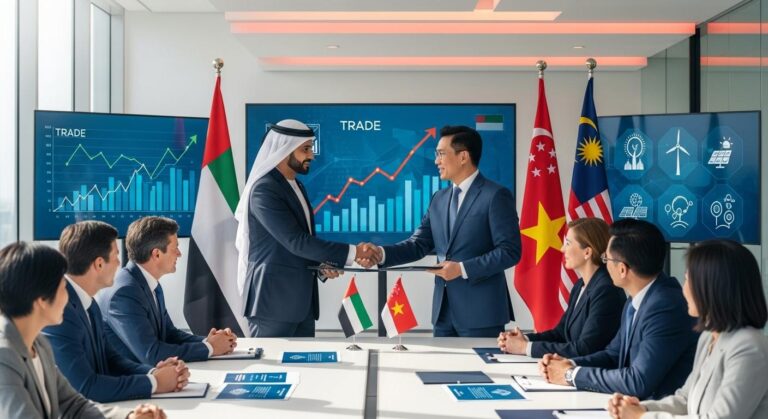
The economic relationship between the United Arab Emirates and Vietnam has grown steadily over the…

The United Arab Emirates continues to expand its global trade network through new economic and…