February 4, 2026
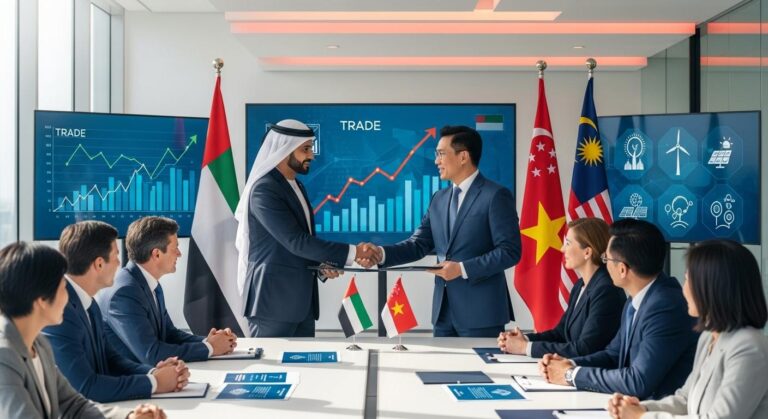
UAE–Vietnam Trade Opportunities
The economic relationship between the United Arab Emirates and Vietnam has grown steadily over the…
Trade between the Gulf Cooperation Council (GCC) countries and Asia has grown significantly in recent years, creating new opportunities for businesses across multiple sectors. Strong economic ties, efficient logistics networks, and increasing demand for goods and services are strengthening commercial relationships between these regions.
The United Arab Emirates plays a central role in facilitating GCC–Asia trade through its advanced logistics infrastructure and global connectivity. Dubai serves as a major gateway for goods moving between Asian manufacturing centers and markets across the Middle East, Africa, and Europe.
With continuous investments in ports, airports, and transportation networks, the UAE is supporting the expansion of trade routes that connect GCC markets with rapidly growing Asian economies.
This article explores the key drivers behind expanding GCC–Asia trade routes and the opportunities they create for businesses.
The GCC and Asia have developed strong economic partnerships based on trade, investment, and industrial cooperation. Asian economies continue to import energy resources, while GCC countries import manufactured goods, technology, and consumer products.
These trade flows support economic growth across both regions.
Businesses benefit from increased demand and stronger market connectivity.
Economic partnerships continue to expand year after year.
Dubai plays a key role in connecting GCC markets with Asia through its advanced logistics ecosystem. The emirate’s ports, airports, and logistics zones allow businesses to move goods efficiently between continents.
Shipping routes from Asia connect directly with Dubai’s major ports.
Companies can distribute products from Dubai across GCC countries.
This strategic connectivity strengthens regional supply chains.
Maritime trade routes remain a major component of GCC–Asia trade. Shipping networks connect major Asian manufacturing hubs with Gulf ports through well-established sea routes.
Modern container terminals in the UAE support high-volume cargo handling.
Efficient maritime logistics reduce transportation costs.
These routes support global supply chain operations.
Air cargo services are also playing an increasingly important role in GCC–Asia trade. International airports in the UAE provide direct connections with major Asian cities.
Air freight enables the rapid movement of high-value and time-sensitive goods.
Advanced cargo facilities support efficient shipment handling.
This connectivity strengthens international trade networks.
Asia is one of the world’s leading manufacturing regions, producing electronics, machinery, textiles, and consumer goods. GCC businesses can import these products and distribute them across regional markets.
Dubai’s re-export model allows companies to redistribute goods efficiently.
Industrial collaboration between GCC and Asian companies is increasing.
This partnership supports long-term trade growth.
Energy trade remains a key component of the GCC–Asia economic relationship. Asian economies rely on energy resources from GCC countries to support industrial development and economic expansion.
Energy exports continue to strengthen trade relations.
Investment in energy infrastructure supports global energy markets.
This sector remains a cornerstone of regional cooperation.
Technology collaboration between GCC and Asian companies is expanding across sectors such as artificial intelligence, telecommunications, and digital commerce.
Joint ventures allow businesses to share expertise and develop new technologies.
Innovation partnerships strengthen economic competitiveness.
These collaborations encourage knowledge exchange.
The rise of e-commerce has created new trade opportunities between GCC countries and Asia. Online marketplaces allow businesses to reach customers across borders more efficiently.
Dubai’s logistics infrastructure supports cross-border e-commerce fulfillment.
Regional distribution centers enable faster product delivery.
Digital trade continues to expand global commerce.
Major infrastructure projects across the GCC are strengthening trade routes with Asia. Investments in ports, logistics parks, and transportation corridors are improving connectivity between regions.
These developments support efficient cargo movement.
Businesses benefit from improved logistics efficiency.
Infrastructure growth encourages international trade expansion.
The future of GCC–Asia trade routes remains highly promising as economic cooperation continues to deepen. Expanding logistics networks, digital trade platforms, and infrastructure investments will further strengthen connectivity between the regions.
Dubai will continue to play a key role in facilitating global trade flows.
Businesses that leverage these expanding trade routes will benefit from growing market opportunities.
The GCC–Asia trade relationship will remain an important driver of global commerce.
The expansion of GCC–Asia trade routes reflects the growing economic cooperation between these regions. Strong logistics infrastructure, increasing investment partnerships, and rising demand for goods and services are driving trade growth.
The UAE, particularly Dubai, serves as a central hub connecting Asian manufacturing centers with markets across the GCC and beyond.
Businesses that take advantage of these expanding trade corridors can strengthen supply chains and access new international markets.
As global trade continues to evolve, GCC–Asia partnerships will remain a powerful force shaping international commerce.
The economic relationship between the United Arab Emirates and Vietnam has grown steadily over the…

The United Arab Emirates continues to expand its global trade network through new economic and…

Global partnerships have become a key driver of international trade and economic development. By strengthening…